What a solar battery does in a working backup system
A solar battery is a storage unit that holds electricity for later use. It works with an inverter, charge controller or hybrid power unit to supply lights, fridges, gate motors, alarms, routers, office gear and selected machinery when grid power is off or when you want to use less municipal power during the day. For many Northern Cape sites, the battery is the part that keeps operations going through evening load-shedding and those short, frustrating supply dips that can spoil refrigeration or trip sensitive equipment.
Good battery storage is not only about backup, it is also about load reduction. If you charge the battery in the middle of the day from solar, you can run a portion of your site on stored power after hours. That helps at workshops in New Park, retail stores in Roodepan, homes in Galeshewe and remote work sites outside Kuruman or Upington where power stability can change from one feed to the next.
Battery sizes and storage options for different loads
We supply battery options in common storage sizes from small single units up to banked systems for larger backup runtimes. Typical usable capacities are 2.4 kWh, 5.1 kWh, 7.2 kWh, 10.2 kWh and 14.4 kWh per unit depending on chemistry and depth of discharge. For light home backup, a 5 kWh to 7 kWh setup often covers lights, TV, Wi-Fi and a fridge for several hours. For a workshop, pump room or small commercial store, 10 kWh to 20 kWh or more may be needed.
The right size depends on the actual load, not just the size of the premises. A cold room, aircon system or borehole pump can draw a heavy start-up current and a battery bank that looks large on paper may still be undersized if the inverter and cabling are not matched properly. We check the expected wattage, the hours of backup required, and whether the battery is for short-term outage cover or daily cycling. Also, in hotter parts of the province battery choice matters because high temperatures can shorten life if the installation space is not managed well.
- Small backup: lights, router, TV, security and one fridge
- Medium backup: household essentials plus small pumps or office equipment
- Heavy use: refrigeration, workshop loads, gate motors and selected tools
- Daily cycling: solar charged storage for daytime use and evening carry-over
Where solar batteries suit best in the Northern Cape
Solar batteries suit places where power interruptions affect comfort, stock or production. In Kimberley they are useful for homes that need fridge continuity and internet during outages, while businesses use them to protect tills, computers, CCTV and refrigeration. On farms and small holdings around the province, battery storage is often paired with solar to support pumps, security and staff accommodation. They also help in areas where supply is weak and people want less dependence on costly generator running.
Battery systems are especially useful for sites with daytime solar generation and evening demand. If your operation starts early and closes after sunset, the batteries can carry the lights and essential loads after the panels stop producing. That makes them practical for medical rooms, small offices, workshops, guest units and cold storage where any interruption is expensive. In coastal or dusty environments, enclosure choice and installation position matter, since heat, salt air and fine dust can all affect battery life and connections.
Installation needs, inverter matching and site power checks
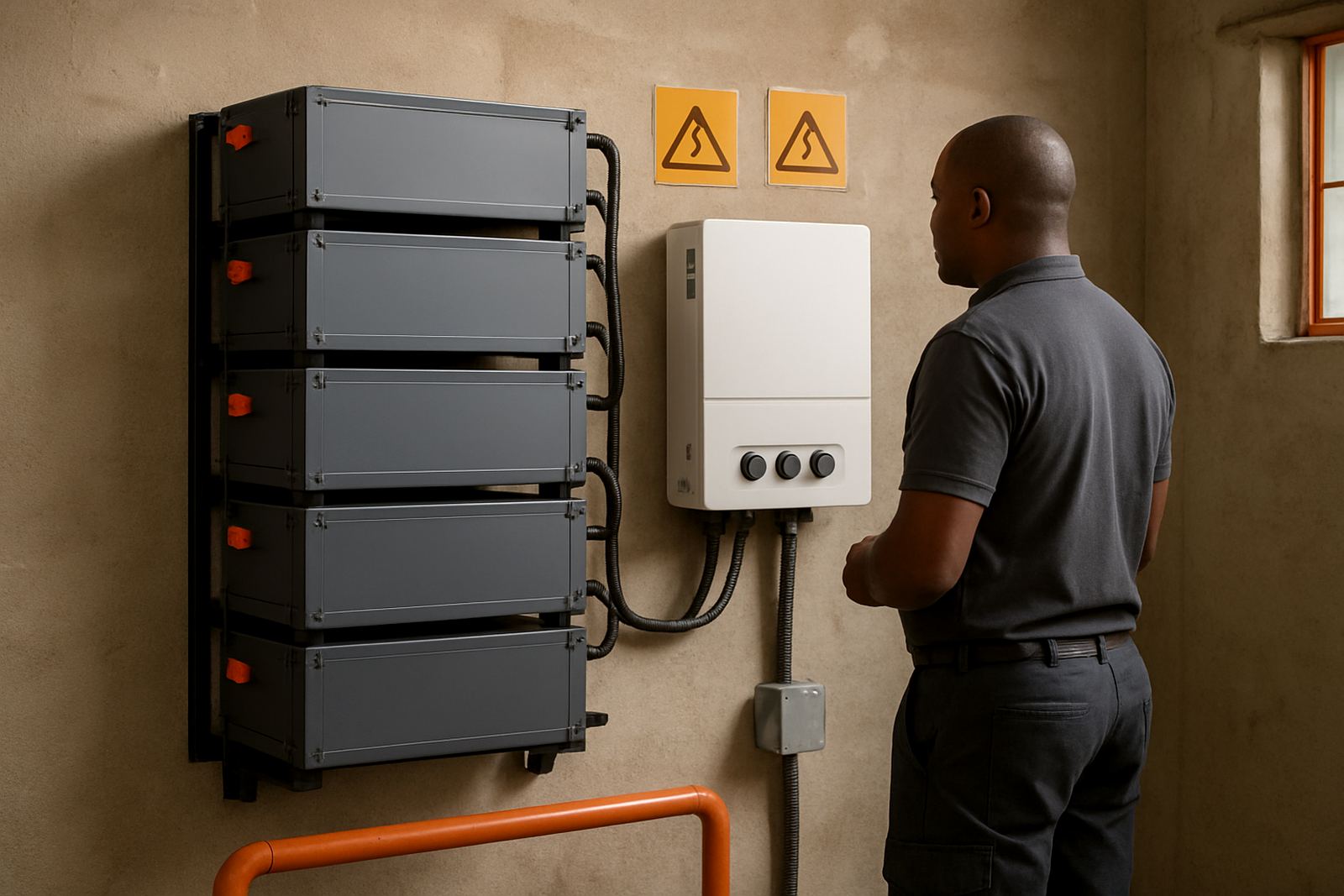
A battery cannot be chosen in isolation. It must match the inverter size, the charging source and the load profile. We check nominal voltage, charge rate, discharge rate and the wiring path before recommending a unit. Most modern systems use 48 V battery banks for better efficiency and cleaner cable runs, while smaller backup solutions may use lower-voltage options for simple loads. Correct cable sizing and protection are important because loose terminations or undersized wire can cause heat build-up and nuisance trips.
For installation we look at wall space, ventilation, clearance and whether the area is protected from direct sun or moisture. Batteries should sit in a dry, stable place with enough room for inspection. If the building already has solar panels or a generator, the controls must be set so the battery charges and discharges in the correct sequence. In some municipal and commercial settings, backup power must also be installed in line with local electrical rules and sign-off requirements, so it is wise to plan for that from the start.
- Confirm inverter compatibility and system voltage
- Check peak load, not only average daily use
- Allow for cable size, breakers and surge protection
- Place batteries where heat and moisture are controlled
Care, servicing and the habits that keep batteries healthy
Battery life improves when the system is set up correctly and checked from time to time. Keep terminals clean, make sure the enclosure is free of dust, and monitor the state of charge so the bank is not left flat for long periods. Where batteries are cycled daily, regular monitoring helps catch weak units early. If a battery room runs hot, life expectancy drops, so ventilation is not a side issue, it is part of the operating cost.
Servicing usually includes checking voltage balance, communication to the inverter, visible signs of swelling or leakage on applicable chemistries, and the condition of the protection devices. If the site uses backup power often, the battery should also be tested under real load rather than only by looking at the screen. A quick inspection after major storms, long outages or a generator transfer issue can prevent bigger failures later. On remote sites, this sort of preventative check saves both travel time and downtime.
What to confirm when ordering solar batteries
Before placing an order, have the load list ready. Note the appliances or equipment you want to keep running, the number of hours needed, and whether the battery is for backup only or for daily charge and discharge. It also helps to confirm the inverter brand and model, the available mounting space and whether the site has single-phase or three-phase power. If the battery will support a pump, refrigeration plant or workshop tools, share the starting surge values too.
It is also worth checking warranty terms, communication compatibility and the battery chemistry. Some systems are better for high-cycle use, while others are suited to occasional outages. If you are near Kimberley, Upington, Kuruman or the surrounding towns, we can help you match the battery to the real site conditions so you do not overbuy or undersize the bank. A few details at the start can prevent a lot of rewiring later.
- Load list with wattage and expected hours
- Inverter type, voltage and communication requirements
- Installation space, ventilation and mounting method
- Whether the system is for backup only or daily solar cycling
- Any pump, refrigeration or motor start-up demands
Key facts
| Battery chemistry | Lithium iron phosphate and other storage options, subject to application |
|---|---|
| Typical system voltage | 24 V or 48 V depending on inverter and load |
| Common usable capacity | About 2.4 kWh to 14.4 kWh per unit, with banked options available |
| Depth of discharge | Often 80 percent or higher on suitable modern units |
| Cycle life | Commonly 3000 to 6000 cycles, depending on chemistry and use |
| Operating environment | Dry, ventilated, shaded area away from excessive heat and moisture |