

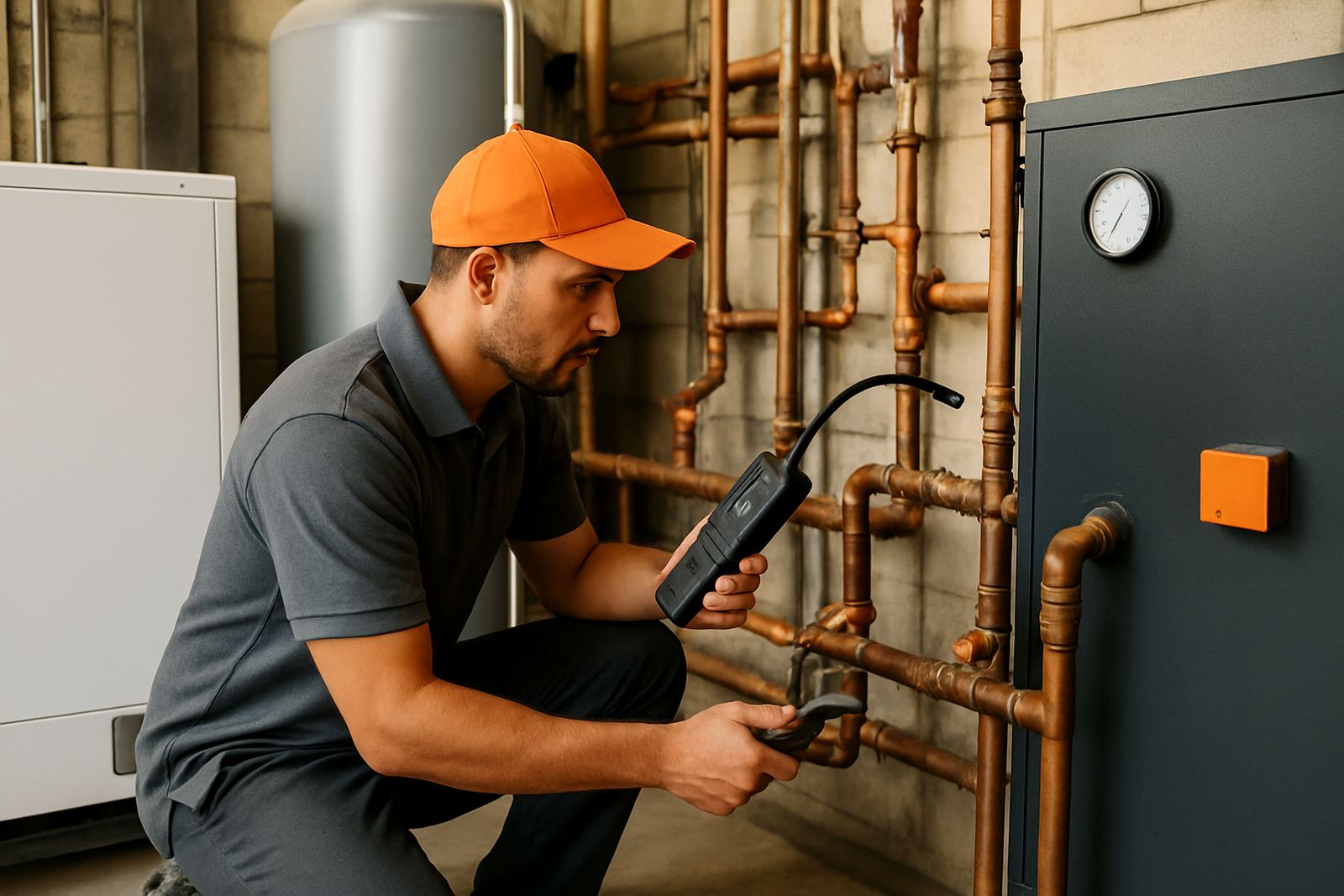
Leak Detectors
Home / Catalogue / Leak Detectors

Catalogue

Leak Detectors

Electronic leak detectors help find refrigerant losses early, before systems run flat or compressors start working harder than they should. They are used on fixed air-conditioning, cold rooms and vehicle aircon, with options for workshop and site use across Kimberley and the Northern Cape.

How an electronic leak detector helps you find the fault fast

A leak detector is a handheld instrument that senses refrigerant escaping from pipe joints, valves, coils, flare fittings and service ports. In practice, it helps technicians move from guesswork to a proper trace, which matters when a system is losing gas slowly and the leak only shows up as weak cooling, icing or repeated top-ups. On a hot Kimberley day, that small loss can turn into a costly call-out very quickly.

These units are used on split air-conditioners, refrigeration plant, cold rooms, water-cooled equipment and auto aircon systems. They are handy where a quick pressure test is not enough on its own, or where access is tight and you need to scan around the pipework and fittings one by one.

  • Detects refrigerant leaks at joints, flares, caps and coils
  • Useful for aircon, refrigeration and vehicle systems
  • Supports fault finding before re-gassing
  • Helps reduce repeat breakdowns and wasted gas

Detector options for workshop and field work

Leak detectors come in a few practical versions. The right one depends on how often you use it, the kind of refrigerant you work on, and whether the tool will live in a workshop or travel with a service technician. Some models are tuned for higher sensitivity, while others are simpler and better for general maintenance work.

For most Northern Cape users, a rechargeable handheld detector is the usual choice because it is easy to carry between sites in Roodepan, Galeshewe, Kuruman or Upington. Some units use replaceable batteries, which can be useful where charging points are not always available during field work.

  • Handheld electronic detectors for general servicing
  • Rechargeable models for regular site work
  • Battery powered models for mobile call-outs
  • Units with visual and audible alarms for faster checking

Where leak detectors suit best in Northern Cape conditions

These detectors suit air-conditioning installers, refrigeration teams, cold room builders, auto aircon specialists and maintenance crews. They are especially useful in dry, dusty areas where fittings can work loose over time, and in coastal or humid environments where corrosion can affect valves and joints. In hot weather, a tiny leak may show up as poor performance long before a system stops completely.

They are also useful during commissioning and after repairs. A system that has had pipework opened, compressor work done or a component replaced should be checked carefully before handover. That way the customer is not left with a unit that loses charge after a few days or weeks.

  • Split units and package air-conditioners
  • Cold rooms and commercial refrigeration
  • Auto aircon systems and workshop diagnostics
  • Plant rooms where regular gas loss is suspected

Power, sensor and gas compatibility to confirm before you order

Not all leak detectors perform the same way, so it helps to check the detail before ordering. You need a unit that matches the refrigerants you are tracing, the sensitivity level you want, and the way your team works. If the detector is too basic it may miss small leaks, but if it is too sensitive and poorly set up, it can give false readings around contaminated areas.

Modern units may be suitable for common HFC and HCFC refrigerants, and some can also help with newer blends depending on the sensor design. Always confirm what gas families the detector can pick up, how long warm-up takes, and whether the unit gives a stable signal in windy or dusty conditions.

  • Check refrigerant compatibility before purchase
  • Confirm battery type and charge method
  • Ask about warm-up time and sensor response
  • Choose sensitivity that suits your fault finding work

Using the detector on site without wasting time

Good leak finding is part tool and part method. A detector works best when the system is reasonably clean around the joints, and when air movement is low enough for the probe to pick up escaping gas properly. Technicians usually start at likely failure points, then move along pipe runs, valves, flare nuts, coil ends and service ports in a steady pattern.

For service teams, it is worth keeping the probe clean and the unit calibrated according to the maker's instructions. A dirty sensor tip or a detector that has been dropped can produce unreliable readings, which is a problem when you are trying to prove a repair before refilling the system.

  • Keep the probe clean and dry
  • Test around valve caps, joins and coil surfaces
  • Use in a steady sweep, not a fast pass
  • Allow the unit to warm up before checking

Care, servicing and parts support

Leak detectors need basic care to stay reliable. The sensor is the part that takes the hardest work, so it should be protected from oil contamination, dust and rough handling. After field use, keep the detector in its case, away from high heat in a bakkie or store room, because excessive heat can shorten sensor life and affect accuracy.

For teams doing daily maintenance, it is wise to check batteries, charging cables and probe condition on a routine basis. If the detector starts drifting, taking longer to respond or giving irregular alarms, it may need sensor replacement or workshop attention. Regular care is cheaper than sending a technician back to a job because a leak was missed the first time.

  • Store away from dust, oil and direct sun
  • Inspect the probe and cable for wear
  • Replace batteries or charge fully before long trips
  • Service when response becomes slow or unstable

What to check when ordering the right detector

When ordering, tell us what systems you work on, whether the detector will be used in a workshop or on site, and what kind of refrigerants you need to trace. That helps us point you to a unit that fits your workload and budget, instead of sending you something too light for commercial work or too complex for straightforward service jobs.

Also note whether you need extra sensors, a carrying case, batteries or charging gear. If your team works between Kimberley, New Park, Kuruman and Upington, a detector with simple charging and decent battery life can save time on long days. If you are doing vehicle aircon, make sure the probe can get into tight spaces around engine bays and dashboards without strain.

  • Type of refrigerant and system size
  • Workshop use or field use
  • Need for rechargeable or battery powered operation
  • Any accessories needed with the unit

Key facts

TypeElectronic refrigerant leak detector
UseAir-conditioning, refrigeration and auto aircon leak tracing
PowerBattery powered or rechargeable options
SensitivitySuitable for fine leak detection on service work
ControlsAudible and visual indication depending on model
Typical useKimberley workshops, field service and commissioning checks

What clients say

Questions we get asked

Can a leak detector find small refrigerant losses?

Yes. A good electronic detector is made for tracing small losses at joints, valves and coils before the system loses too much charge.

Will it work on vehicle aircon systems?

Yes, provided the detector is compatible with the refrigerant type in the vehicle system and the probe can reach the test points properly.

Do I still need pressure testing or soap solution?

Often yes. A leak detector is one part of the fault finding process, and it works best alongside proper service checks and pressure testing.

Planning something? Email the team.

info@modernequipment.co.za