What a ceiling cassette unit does
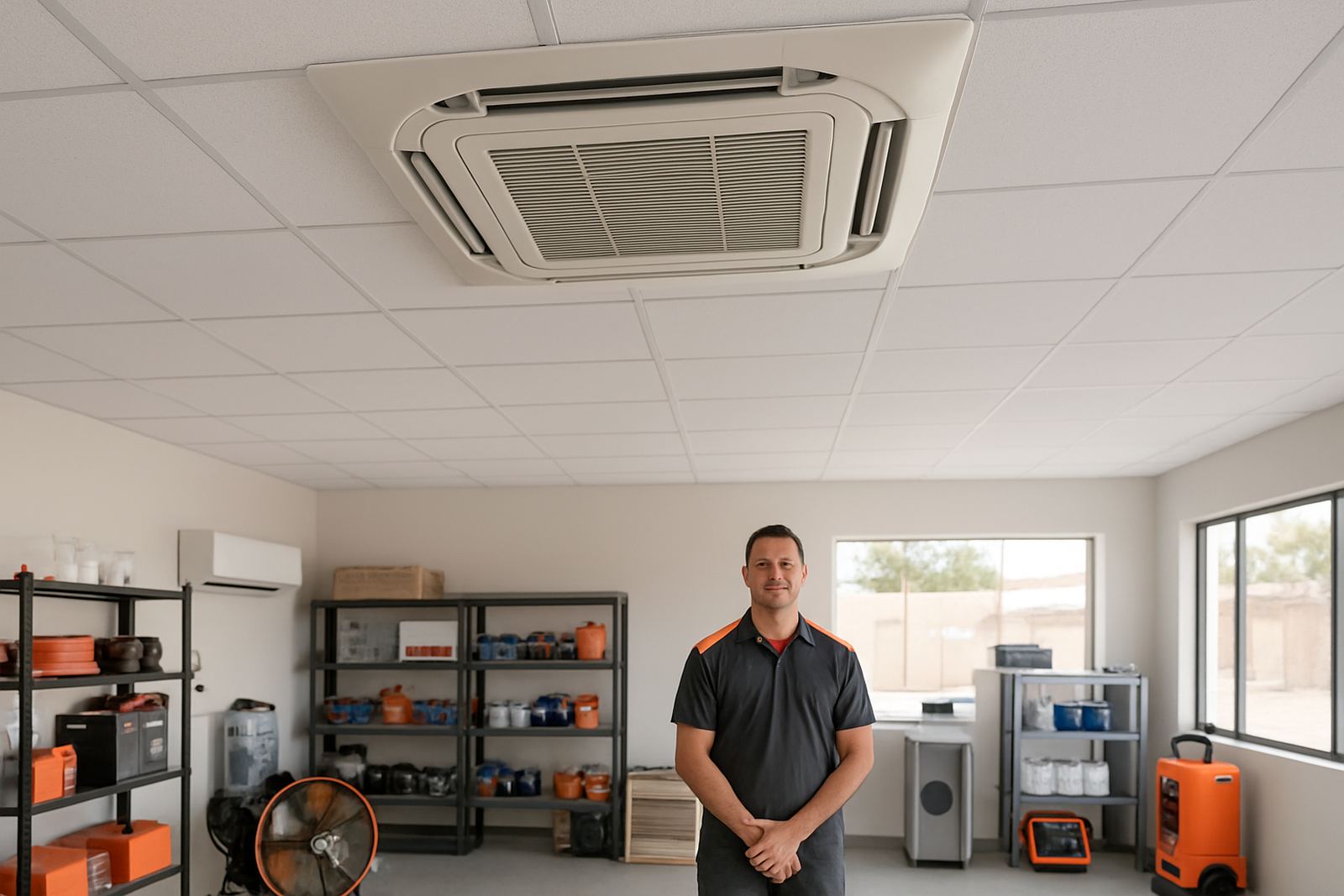
A cassette air conditioner is mounted into a ceiling void so only the decorative indoor face is visible below. It draws warm air from the room, cools it through the indoor coil and spreads the conditioned air across four sides for a more even feel than a wall unit in many open areas. This helps reduce hot spots near glass fronts, tills, reception counters and walkways.
For businesses in New Park, Galeshewe, Roodepan and the central Kimberley area, cassette units are a tidy option where wall space is already taken up by shelving, display fridges or notice boards. They are also a good fit for consulting rooms and meeting spaces where you want the air movement to be felt without a unit hanging on the wall.
- Flush ceiling finish with visible front grille only
- Even airflow in four directions
- Good for open-plan commercial rooms
- Works with standard split-system outdoor units
Sizes, capacities and common options
Cassette units are usually selected by cooling load rather than by room size alone. A small office or service area may work with a lower-capacity unit, while a busy shop floor or waiting room often needs a larger model with stronger airflow and a wider throw. We help match the unit to the actual heat load, not just the floor plan, because glass, people, equipment and roof heat all matter.
Common options include standard cooling-only units, reverse-cycle units for cooling and heating, and inverter-driven models for steadier operation and lower current draw. Inverter models are useful where the room occupancy changes through the day, since they can modulate instead of cycling hard on and off. That can help during load-shedding recovery and keep starting surge lower, though you still need proper backup planning.
- Cooling capacities commonly from 2.6 kW to 14.0 kW and above
- Single-phase and three-phase supply options
- Inverter and non-inverter choices
- Remote control, timer and temperature control functions
Where cassette aircon suits best
These units suit open-plan shops, supermarkets, reception areas, schools, waiting rooms, small restaurants, offices and light industrial admin spaces. They are especially useful where people move around the room and a single wall jet would be uncomfortable. In the Northern Cape heat, that even spread matters when the afternoon sun loads up a front room or a west-facing office.
Cassette units are not the best choice for every site. If the ceiling void is too shallow, access is poor, or the roof structure cannot take the weight and service clearance, another indoor format may be a better call. We check the site first so the install is practical and safe, not squeezed in and difficult to maintain later.
- Open-plan retail floors
- Waiting areas and reception zones
- Boardrooms and training rooms
- Medical and professional consulting spaces
Installation needs, power and pipework
A proper cassette installation needs enough ceiling depth, a sound mounting frame, drain fall or a pump where required, and correct pipe routing to the outdoor condenser. The refrigerant lines must be sized to suit the capacity and installed cleanly to keep pressure drop and oil return within spec. If the drain line is not planned properly, you can end up with water marks or dripping ceilings after a few months, which is costly to fix.
Electrical supply is just as important. Smaller units may run on single-phase 230 V, while larger commercial units may need three-phase power depending on the model and the site load. In Kimberley and surrounding towns, we often check the distribution board, breaker capacity and whether backup supply or solar integration is part of the job. During load-shedding, the unit may need to restart on a generator or inverter system, so starting current and supply stability must be considered from the start.
Refrigerant charge should be set according to the line length and manufacturer data for the selected unit. If lines are extended beyond standard lengths, the gas charge normally has to be adjusted. On service calls, we inspect for leaks, blocked drains, dirty filters and signs of coil corrosion, especially on sites with dust or where salty air reaches from the broader coastal supply chain on equipment stored for long periods. It is a simple thing, but a clean coil saves power and improves airflow.
Care, servicing and daily use
Cassette units are dependable when filters are cleaned regularly and the drain system is kept open. In dusty areas around Kimberley, Kuruman and Upington, filters can load up faster than people expect. When airflow drops, the unit works harder, temperatures swing more and electricity use climbs. A blocked drain can also cause overflow into the ceiling void, so it is worth checking before the busy season.
We recommend routine servicing on commercial units, especially where the aircon runs most of the day. A proper service usually includes filter cleaning, coil washing, checking fan motors, testing controls, tightening electrical connections and confirming the refrigerant pressures. If the room smells musty or the unit is short-cycling, that is a sign something needs attention before bigger damage sets in.
- Clean or replace filters on a regular schedule
- Keep supply and return grilles clear
- Check drainage before the rainy season
- Book servicing before peak summer use
What to check before you order
Before choosing a cassette unit, check the room size, ceiling void depth, power supply, window area, expected number of occupants and whether the space must cool after hours. If the room has stock shelves, fridges, servers or kitchen equipment, the heat load rises and the unit size may need to increase. It is better to specify correctly at the start than to run an undersized unit flat out all day.
Also think about service access. A cassette needs space above the ceiling for maintenance, so if the roof is tight, the installation team may need to plan an access panel. For commercial sites, the outdoor unit position matters too. It should have enough fresh air, no direct obstruction, and a location that respects municipal noise and nuisance rules where those apply. On a busy site, a poor outdoor position can become an issue for neighbours or staff.
- Room dimensions and ceiling height
- Available power supply and breaker size
- Whether backup power will be used
- Drain route and service access above the ceiling
Local supply and support from Kimberley
Modern Equipment supplies cassette aircon units from our base in New Park, Kimberley, with support for sites across Roodepan, Galeshewe, Kuruman and Upington. Our team handles aircon installation, servicing, commissioning support and related HVAC work, so the unit can be matched to the building and maintained properly after handover. We also assist with pumps, refrigeration and solar backup when a site needs more than one system to work together.
If you are fitting out a new shop, upgrading a waiting area or replacing an older ceiling unit, we can help with selection, installation and after-sales support. A well-sized cassette unit should cool the room evenly, start reliably and stay easy to maintain. That is the aim, and it starts with the right spec on day one.
Key facts
| Unit type | Ceiling cassette split air conditioner |
|---|---|
| Typical cooling range | 2.6 kW to 14.0 kW and above |
| Power supply | 230 V single-phase or three-phase, model dependent |
| Air distribution | Four-way discharge for even room coverage |
| Controls | Remote control, timer and selectable fan speeds |
| Common applications | Shops, offices, waiting rooms, boardrooms and medium commercial spaces |