What a portable aircon unit does on site
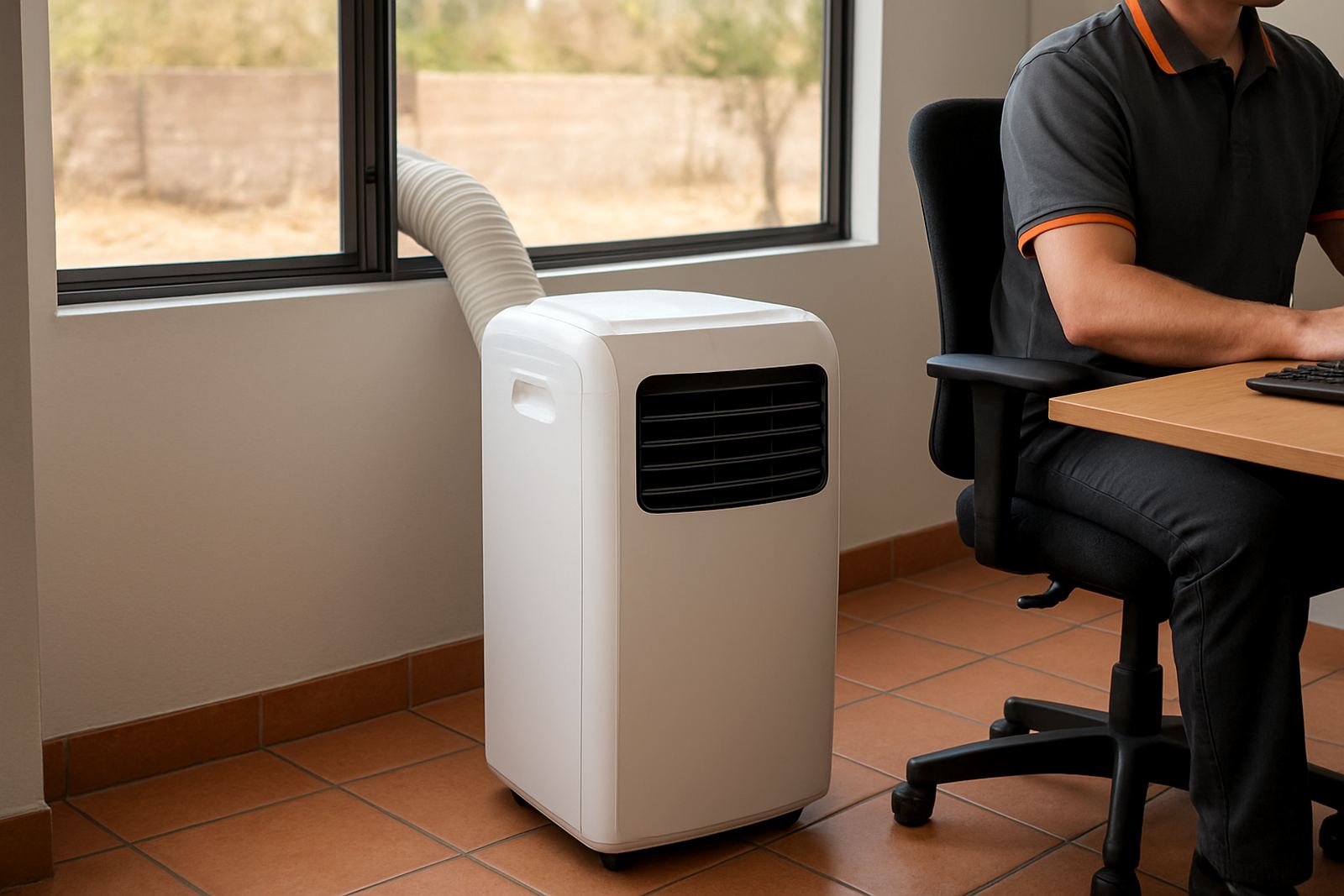
A portable aircon unit is a moveable cooling machine that sits inside the room and pushes warm air out through a duct. It is used where you need short term or flexible cooling, such as a small office, guard room, server room, rental unit, shop counter area, or a room that keeps changing layout.
These units are handy in Kimberley and surrounding towns when building work is still going on, a fixed system has not been installed yet, or you need cooling during load-shedding recovery and hot afternoon peaks. They are not the same as a swamp cooler. They remove heat and, on many models, also take some moisture out of the air, which helps in closed rooms where equipment and people are under strain.
For best results the room should have a way to vent hot air out of a window, wall opening, or ceiling hatch. If the hot air stays in the room, the unit will fight against itself and the room will feel stuffy. Correct sizing matters as much as the machine itself.
Sizes and options that suit Northern Cape conditions
Portable units come in different cooling capacities, usually measured in BTU or kW. A smaller unit is suitable for a guard room, ticket office, small bedroom or compact server cabinet area. A mid-size unit can handle a small shop, consulting room, home office or temporary admin space. Larger portable models are better for open areas, event spaces, classrooms, and back-of-house rooms that take a lot of sun through windows.
When choosing a unit, look at these options:
- Single-hose or dual-hose cooling, depending on how much outside air the room can handle.
- Manual drain or self-evaporating condensate handling for wet conditions.
- Timer and thermostat control for overnight use and monitored spaces.
- Castors and handles for moving between rooms, with enough clearance around the unit.
- Dehumidify mode for damp summer conditions or rooms with equipment.
In hot, dry weather a portable unit can still work well, but rooms with large glass areas, poor sealing or strong west-facing sun may need a bigger size than expected. It is worth checking the room volume, not only the floor size, before ordering.
Where portable cooling is the better choice
Portable cooling is useful when you need a fast answer and a fixed installation is not yet possible. It suits temporary classrooms, rental properties, events, reception points, workshops, meter rooms, server rooms and short-term project offices. It also helps when one part of a building is hotter than the rest, such as a storeroom above a ceiling, a guardhouse or a communications room.
In commercial settings, temporary cooling often keeps staff working while a permanent system is serviced or upgraded. In homes it can bridge the gap during renovations, or cool one room at night without running the whole house. For server rooms, the main aim is steady temperature, not just comfort. That means keeping the door closed, sealing gaps, and making sure the unit can run for long periods without interruption.
Portable units are not ideal for very large open workshops, kitchens with heavy heat loads, or areas where there is nowhere for the exhaust duct to discharge. In those cases it may be better to look at a fixed air-conditioning solution or a ventilation change.
Power supply, drainage and venting to plan for
Most portable aircon units run on standard 230 V single-phase power, but the starting load still needs checking. A dedicated plug point is preferred, and long extension leads should be avoided where possible. If the unit shares a circuit with computers, fridges or power tools, tripping can become a problem. For premises affected by load-shedding, it is also worth confirming that backup power can carry the start-up draw and running load.
The unit will need a way to discharge hot air. This is usually done with a flexible exhaust hose through a window insert, a wall vent, or a temporary opening that can be closed around the hose. The shorter and straighter the hose, the better the cooling performance. Long bends, crushed ducts and poor sealing all reduce output.
Drainage depends on the model and the humidity in the room. Some units collect water in a tank that must be emptied, while others evaporate most of it through the exhaust. If the unit will run for many hours, especially in closed rooms or during humid spells, check whether a drain hose can be fitted. It saves time and cuts down on overflows.
Care and servicing that keep the unit working
Portable units need regular attention if you want steady cooling. The filters should be cleaned often, especially in dusty areas, workshops or rooms near traffic. A blocked filter reduces airflow and makes the machine work harder. The exhaust hose should also be checked for cracks, loose fittings or heat damage.
Basic care includes:
- Wiping dust from the intake grilles and filter every few weeks.
- Checking the condensate tank or drain hose before long runs.
- Keeping the unit upright during transport and before switching on.
- Making sure the room is closed while the machine is running.
- Booking a service if cooling drops, noise increases, or the compressor cycles too often.
If a unit is being moved between sites, it should be handled carefully because rough transport can loosen internal parts. In a commercial setting it pays to keep a simple log of cleaning and service dates so the unit does not fail during peak heat.
What to check before you order
Before you place an order, check the room size, ceiling height, window or wall venting options, power point position and how many hours a day the unit must run. Also note whether the room holds people, electronics, or both. A server room has different needs to a temporary office, and a room with strong sun through glass will need more capacity than a shaded room of the same size.
Please also confirm whether you need one unit or several units for different spaces. Sometimes two smaller machines give better coverage than one large unit, especially where heat is spread across separate corners. If you have a plan for backup power, tell us the available inverter, battery or generator size so the recommendation matches the supply.
For customers in New Park, Roodepan, Galeshewe, Kuruman and Upington, a clear list of room measurements, photo's of the space and the power setup makes the process faster. It helps us match the unit to the actual conditions instead of guessing from a floor area alone.
Local supply and support from Kimberley
Modern Equipment supplies portable aircon units from New Park, Kimberley across the Northern Cape. Our team works with air-conditioning, refrigeration, ventilation, pumps and solar backup, so the advice you get is practical and based on how equipment behaves in local heat, dust and supply interruptions.
We can assist with selection, setup guidance, servicing and follow-up support for temporary or permanent cooling needs. Whether you are cooling a short-term workspace or trying to protect sensitive equipment in a small room, we help you choose a unit that fits the job and the power available.
Key facts
| Cooling capacity | Approx. 9,000 to 24,000 BTU, depending on model |
|---|---|
| Power supply | 230 V single-phase, subject to unit size |
| Typical coverage | Small room to medium space, based on heat load and sealing |
| Air movement | Flexible exhaust duct required for hot air discharge |
| Drainage | Tank or continuous drain option on selected models |
| Mobility | Castors and side handles for room-to-room movement |