Retail spaces that stay comfortable from open to close
Shops in Kimberley, Roodepan, Galeshewe, Kuruman and Upington face a mixed load. You get midday heat, doors opening all day, people standing near tills, and fridges working hard in the background. In small convenience stores a single weak aircon unit can leave the front counter hot and the stock room stuffy. In larger retail spaces the problem grows fast if the cooling is not matched to the floor area, ceiling height and glass frontage.
For customer facing spaces, the aim is steady comfort rather than icy air. A shop that feels even and fresh keeps people browsing longer, and it helps protect chocolates, dairy, drinks and other temperature sensitive stock. If the entrance is pulling in dust or hot air every time the door opens, the whole room works harder. That means higher power use and more wear on compressors, fans and motors.
We work with shop owners, tenant fit-out teams and property managers who need a practical setup that can handle load-shedding and long trading hours. Whether it is a corner store, takeaway, pharmacy, clothing shop or hardware outlet, the system needs to fit the trading pattern not just the floor plan.
Typical equipment for a shop setup
A retail cooling and refrigeration package usually combines more than one system. The exact mix depends on the size of the shop, the product range and how many people move through the doors each hour. For example, a bottle store has different needs to a bakery or supermarket-style front shop.
- Split-type or cassette air conditioners for sales floors, offices and back rooms
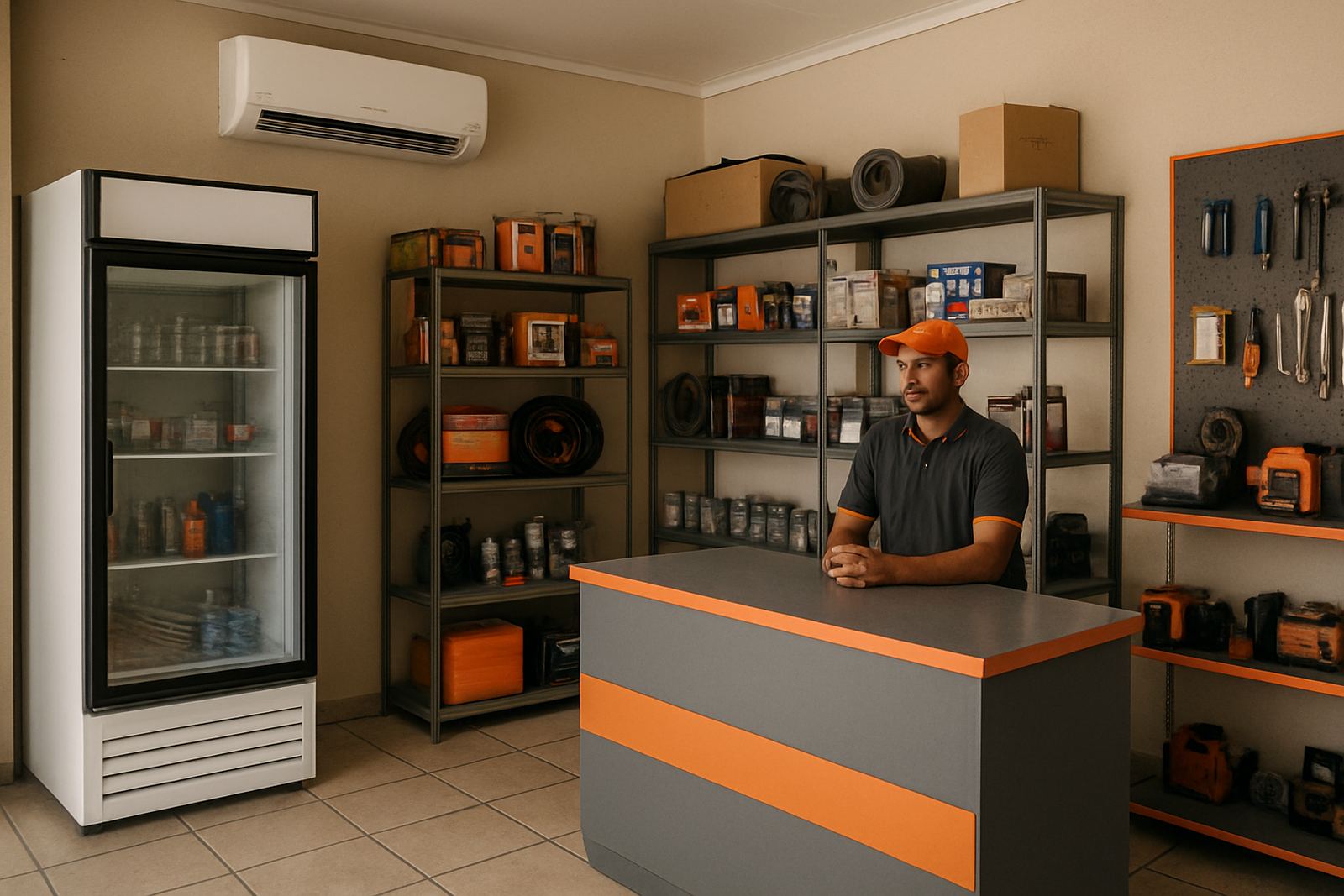
- Display fridges and chillers for drinks, dairy, meat or grab-and-go items
- Cold room panels and condensers for bulk stock or back-of-house storage
- Extract fans and supply fans for prep areas, storerooms and toilets
- Air curtains or controlled entrance airflow where dust and hot air are a problem
- Backup solar support or battery-ready supply for critical cooling during outages
In Northern Cape conditions, equipment selection matters. A unit that works well in a coastal town may not cope as well with Kimberley heat, fine dust and doors opening all day. Motor size, refrigerant line length, drain routing and power supply all need to be planned before anything is fixed to the wall. That includes making sure the shopkeeper can still service stock without blocking vents or damaging pipework.
Layout and planning that saves power and complaints
Good planning starts with the customer flow. The coldest point in the shop should not be right at the entrance, and the warmest equipment should not be boxed into a corner with no air movement. A common mistake is to overcool one zone while the till area stays warm. Another is placing display fridges in direct sun or beside a doorway where hot air keeps cycling through the cabinet. That drives up running costs and shortens equipment life.
We usually look at ceiling height, window size, door traffic, existing power points and where drainage can run without nuisance leaks. In many shops, especially rented premises, wall strength and ceiling access matter as much as the cooling load. If the landlord wants minimal structural changes, the system must be planned around what is already there.
For entrance areas, a simple airflow plan can make a big difference. It may be a correctly sized air curtain, a repositioned supply vent or a small vestibule style arrangement to slow down hot air entering the store. In towns like Upington and Kuruman, where people often come in from strong sun and dust, this helps keep the shop cleaner and more comfortable.
Common mistakes that cost money later
Retail owners often try to save money by undersizing the system or by buying one unit to do too much. That can work for a short while, then the complaints start. Customers say it feels too warm, staff keep adjusting settings, and the compressor runs longer than it should. Once that happens, power bills rise and breakdowns become more likely.
Another mistake is skipping maintenance because the equipment still switches on. In shops, dirty filters, blocked drains and weak gas charge can hide for weeks before the problem shows itself as poor cooling or spoiled stock. Refrigeration also needs clean condenser coils and correct cabinet temperatures. If the seals are worn, cold air escapes and the motor just keeps working harder.
- Do not place fridges where they bake in direct sunlight
- Do not block vents with signage, boxed stock or shelves
- Do not ignore dripping drains, rattling fans or warm cabinet edges
- Do not run critical stock on a system that has never been load tested during power cuts
When a shop has to keep trading through load-shedding, every weak link shows up fast. A backup plan for the refrigeration load can prevent spoilage and help protect the day’s takings. It also gives staff some peace of mind when the power trips without warning.
Budget ranges for shop cooling and refrigeration
Budget depends on size, brand of equipment, whether the premises already has electrical capacity, and how much pipework or cabinet work is needed. A small shop with one or two split systems and a basic display fridge setup will cost far less than a larger store with multiple cold rooms, entrance airflow and backup power support.
As a practical guide, aircon supply and installation for a small retail area can start from around R12 000 to R25 000 per unit, depending on capacity and site conditions. Mid-size shop cooling packages often sit between R35 000 and R120 000 when more than one zone is involved. Display refrigeration and cold room work can range from about R18 000 for smaller cabinets or repairs, up to R250 000 plus for larger walk-in storage, controls and commissioning.
Repair call-outs, servicing and gas top-ups are usually the lower-cost line items, but they should be treated early. A blocked drain or failing fan bearing is much cheaper to sort than a spoiled stock event. If you are budgeting for a new shop fit-out, it is worth setting aside a maintenance amount as well, not only the install cost.
How Modern Equipment supports retail clients
Modern Equipment has been serving Kimberley and the Northern Cape since 2002 from New Park, Kimberley. Our team works with retail clients who need supply, installation, servicing and repairs without long delays. That includes air conditioning, refrigeration, ventilation, pump work and solar backup support where power stability matters.
The team includes Marius Jacobus van der Merwe, Lerato Mokoena, Pieter Johannes Botha, Ayanda Ndlovu, Charlene Daniels, Thabo Molefe and Nadia September. Between sales, workshop support, field service and parts handling, we can assist with new shop fit-outs, problem units, scheduled maintenance and follow-up support after commissioning.
If your shop is in New Park, Roodepan, Galeshewe, Kuruman or Upington and you need a practical cooling plan, send through the store size, the type of products you sell and any photos of the current layout. It helps us advise on what can stay, what should be moved, and where the real pressure points are. We can then recommend equipment that suits the site and the trading hours, without overspending on parts you do not need.