

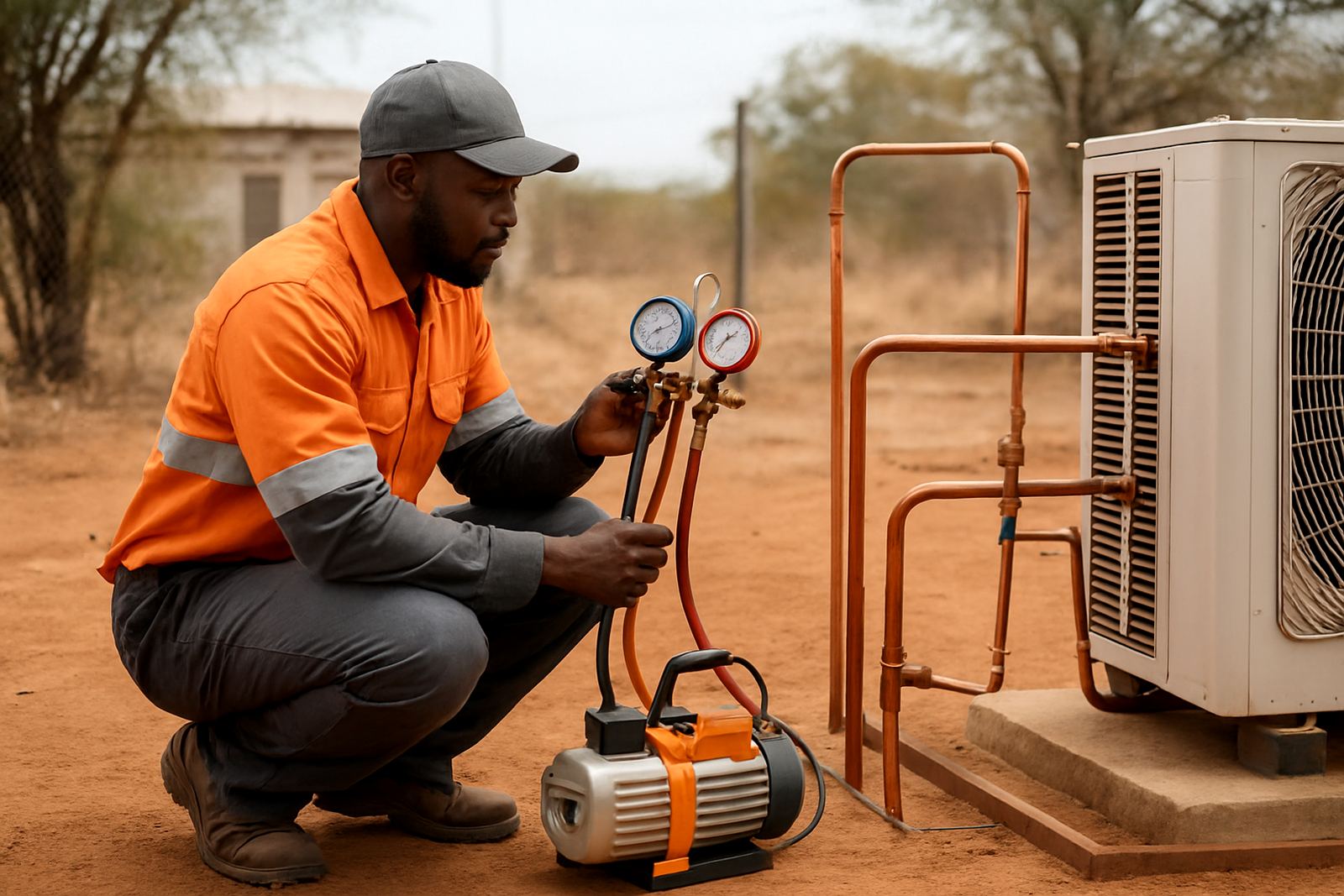
Why Vacuuming Matters
Home / News / Why Vacuuming Matters

News

Why Vacuuming Matters

A proper vacuum is not just a step on the checklist, it is what clears out moisture and air before gas goes in. Skip it, and you can end up with poor cooling, acid build-up, ice at the valves, and a call-back when the job should have been done once.

Why vacuuming is part of a proper charge-up

When an HVAC or refrigeration system is opened to atmosphere, it does not just pick up a bit of dust. It takes in air, water vapour and fine contamination that can sit inside the pipework, indoor coil, outdoor unit and the compressor. A vacuum pump removes those gases and helps pull the system down to a low pressure before charging.

That matters because refrigerant must work in a clean, dry circuit. If you charge too soon, moisture can mix with the refrigerant and oil, then start causing corrosion, acid and blockages. The system may still run, but not properly, and the customer in Kimberley or Kuruman is left with weak cooling and higher power use.

  • Air left in the system reduces cooling performance.
  • Moisture can freeze and cause expansion device problems.
  • Contamination shortens compressor life.

What moisture does inside the pipework

Moisture is one of the main reasons a new or repaired system fails early. Even a small amount can cause trouble once the system starts cycling under pressure. In summer heat, or when a cold room runs hard through the day, that moisture can move around as vapour, then condense in colder parts of the circuit.

In practical terms, that can mean ice at the capillary or thermostatic valve, fluctuating suction pressure, and oil that no longer carries heat away from the compressor like it should. Over time the oil can break down. Then you are not only looking at a service issue, but possible component damage that costs far more than a proper evacuation would have.

  • Free moisture can freeze and restrict flow.
  • Moisture plus refrigerant can form acids.
  • Acids attack windings, valves and bearings.

Vacuuming is not the same as just releasing pressure

A lot of people think if the system holds pressure, it must be ready. It is not that simple. Pressure testing and vacuuming do different jobs. A pressure test checks for leaks with dry nitrogen or another suitable inert gas. Vacuuming removes air and vapour after the leak test is complete.

If a team skips the evacuation stage, or uses a weak pump with poor hoses, they may only be removing some of the air. That is not enough for a system that needs reliable operation in a hot Northern Cape summer, or in a workshop where auto aircon units are expected to cool fast after a long drive.

  • Pressure testing finds leaks.
  • Vacuuming removes air and moisture.
  • Both steps are needed before final charging.

How a proper evacuation job should be handled

A good vacuum job starts with clean pipework, correct brazing and proper leak testing. After that, the technician connects a service gauge set and a vacuum pump with hoses that are in good condition. The system should be pulled down steadily and held there long enough to remove moisture from hidden spots like bends, valves and receiver lines.

For larger systems such as cold rooms or ducted installations, the process can take longer than people expect. Deep vacuums are not a rush job. The technician should watch the micron level or at least confirm that the system holds vacuum for a period after the pump is isolated. If it rises fast, there is still moisture or a leak somewhere.

  • Use hoses and fittings that do not leak under vacuum.
  • Allow enough time for moisture to come out of the oil and pipework.
  • Verify the vacuum holds before charging.

Why it matters even more in Kimberley and nearby towns

In the Northern Cape, conditions can work against a system from day one. Heat, dust and long running hours put extra strain on air-conditioning and refrigeration equipment. In places like New Park, Galeshewe, Roodepan, Upington and Kuruman, a unit may be installed in a home, shop or workshop where the equipment sees hard use and load-shedding adds more starts and stops. That extra cycling does not forgive poor installation practice.

We also see systems in dusty areas where filters and coils already need more attention than usual. If the pipework has moisture inside it as well, the system has two problems at once. That is why a proper vacuum before charging is not a nice-to-have, it is part of doing the job right the first time.

  • High heat puts pressure on compressor efficiency.
  • Dust loads coils and forces longer run times.
  • Frequent outages make weak systems fail sooner.

What customers should ask before the gas goes in

If you are paying for an installation or repair, ask what steps were done before charging. A qualified technician should be able to explain the pressure test, the evacuation process and how they confirmed the system was dry. If the answer is vague, that is a warning sign.

It is also worth asking whether the correct vacuum pump, gauges and recovery equipment were used, and whether the system was left to settle before final charging. A quick top-up might look cheaper on the day, but it can cost more once the compressor starts making noise or the unit no longer cools properly. Small details matter here, and a missed step can undo good work.

  • Ask if the system was pressure tested first.
  • Ask how the vacuum was checked.
  • Ask if the charge was set to the correct specification.

Questions we get asked

Why do you need a vacuum before charging an aircon system?

A vacuum removes air and moisture from the pipework and components. That helps the refrigerant work properly and reduces the risk of acid, ice and compressor damage.

Can a system that holds pressure still need vacuuming?

Yes. Holding pressure only shows the system is not leaking at that moment. It does not remove moisture, and moisture is one of the biggest causes of later faults.

How can I tell if the vacuum job was done properly?

The technician should be able to explain the pressure test, show that the system held vacuum, and confirm that charging only started after the evacuation was complete.

Planning something? Email the team.

info@modernequipment.co.za