Why Outdoor Units Fail Earlier in Northern Cape Conditions
Outdoor air-conditioning, refrigeration and ventilation units do not fail overnight. More often, they get weakened by dust, direct sun, blocked airflow and small impacts from trolleys, garden tools or loose roofing material. In New Park, Roodepan and Galeshewe, we see the same pattern year after year: the unit works hard through hot afternoons, then runs under pressure when the dust builds up around the coil and fan.
Kimberley heat is one part of the story. The other part is the fine dust that gets into fins, motors and electrical compartments. If a unit sits on bare ground or close to a busy passage, it also picks up accidental damage. That may start as a bent guard or a cracked cover, then turn into higher running costs and repeated faults.
- Dust reduces heat transfer and makes the unit run longer
- Sun dries out plastics, wiring sleeves and seals faster
- Loose debris can block fan blades or damage coils
- Small knocks can bend pipework and loosen mounts
Set the Unit Up Where It Can Breathe
The best protection starts with correct placement. An outdoor unit still needs open space around it, even if it is under a shelter. If it is wedged against a wall or squeezed into a corner, hot air recirculates and the compressor works harder. That extra strain shows up in higher power use and shorter part life.
When we install or service equipment, we look for a position that keeps the unit clear of foot traffic, floodwater and roof runoff. In parts of Kimberley, sudden rain can run down paving and collect where a unit was placed too low. A solid stand or wall bracket helps, but it must be level and fixed properly. No wobble, no vibration, no shortcuts.
- Keep clear space around the sides and top of the unit
- Lift the unit above dust, splashback and standing water
- Use proper mounts so the frame does not shake loose
- Keep it away from windows where hot discharge air may cause discomfort
Use Shade Without Trapping Heat
A shade structure can help a lot, especially on west-facing walls that take afternoon sun. But shade must be open enough for airflow. A closed box or tight cover traps heat and can do more harm than good. The goal is to reduce direct sun, not to smother the equipment.
For homes and small businesses, a simple roof overhang or purpose-built canopy is often enough. On larger sites in Kuruman or Upington, the setup may need a more careful layout so the unit is shaded while still getting free movement of air. If the unit sits in a courtyard or next to a wall, the reflected heat can matter just as much as the sun overhead.
One practical rule is this: if the shade makes the area feel still and hot, it is probably too enclosed. A unit that is shaded but able to discharge heat freely will usually last longer and use power more efficiently.
Stop Dust Before It Reaches the Coil
Dust is one of the biggest enemies of outdoor equipment in the Northern Cape. Even when the unit is working fine, a thin layer of dust on the coil acts like a blanket. It makes the machine run hotter and can lead to nuisance trips or weak cooling. In commercial spaces, that means complaints from staff, stock risk and unhappy customers.
Regular cleaning is important, but prevention helps too. Trimming nearby shrubs, sweeping loose gravel away from the base and keeping building works at a sensible distance all make a difference. If there is a workshop or service yard nearby, try to avoid storing cardboard, plastic wrap or other light debris close to the unit because it gets sucked into the intake. A little housekeeping goes a long way, even if it sounds basic.
- Wash or brush dust off coils before it hardens
- Keep the ground around the unit clear of stones and litter
- Do not lean ladders, pipes or scrap against the casing
- Check that drain outlets are not blowing dust back into the unit
Protect Against Knocks, Vandalism and Loose Material
Accidental damage is more common than people think. A passer-by can bump a unit with a wheelbarrow, a child can throw a ball into a grille, or a contractor can rest materials against it during a job. In industrial and retail areas around Kimberley, we often see units damaged by unsecured fencing, building debris or poor traffic flow. It only takes one bent fan guard to start a chain of faults.
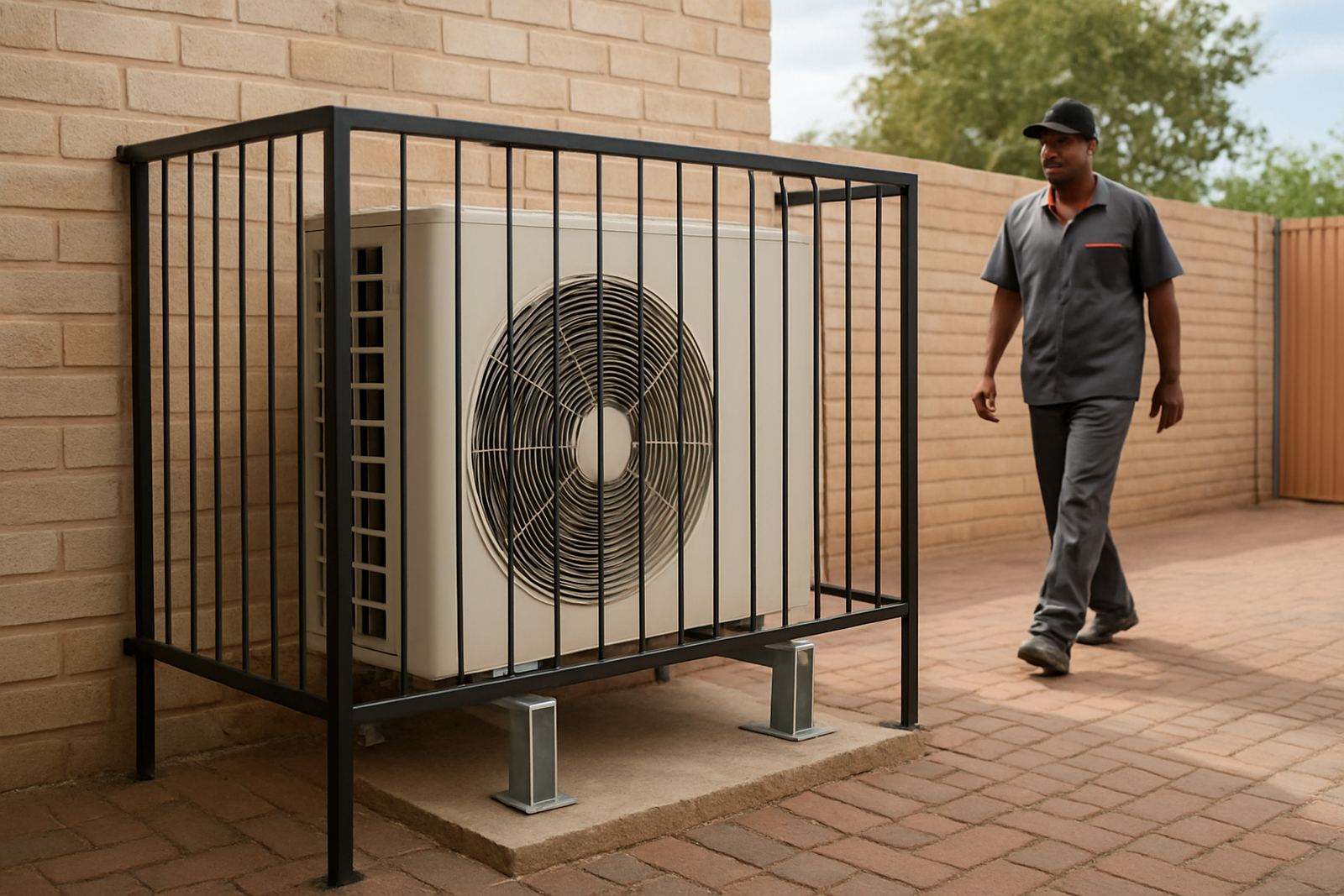
If a unit is in a public or semi-public area, a simple protective barrier may be worth it. The barrier must still allow air movement and access for servicing. Locked access is useful too, especially where copper pipes and cabling are exposed. If the pipework runs low along a wall, it should be clipped neatly and protected from accidental kicks or tools.
- Fit a guard or barrier where vehicles or people pass close by
- Secure copper lines and electrical cables neatly against the wall
- Keep the area free of loose materials during building work
- Check that the unit cover panels are intact and fastened properly
Keep Electrical Parts Safe During Load-Shedding and Storms
Outdoor units also need protection from electrical problems. Load-shedding, voltage swings and storms can all affect motors, contactors and control boards. If the supply comes back with a spike, a unit may trip or suffer damage that is not obvious at first. Later, the client only notices that the system struggles to start or the fan runs erratically.
For that reason, correct isolators, clean wiring and proper earthing matter. Surge protection is worth considering where power quality is poor or where equipment is important to the business. If a site has solar backup, the changeover equipment must be set up properly so the outdoor unit does not get repeated hard starts. This is where commissioning support helps, because the installation is only as good as the final checks.
After a storm or a long outage, it is smart to inspect the outdoor unit before restarting it. Look for water inside the electrical box, loose clips or any sign that debris has shifted the casing out of place.
A Simple Maintenance Routine That Pays for Itself
Protecting outdoor units is not a once-off job. It is a habit. A short inspection every few weeks can catch minor issues before they become expensive repairs. In a place like Kimberley, where dust and heat never really take a break, that routine matters all year.
A useful checklist is easy to follow and does not need special equipment. Keep it practical, repeat it after strong winds or building activity and log any faults so nothing gets missed. The same approach applies whether the unit is on a small house, a shopfront or a cold room system.
- Check that airflow is clear on all sides
- Look for bent fins, loose mounts or rattling panels
- Clean dust from the coil before it packs tight
- Confirm the drain, isolator and cable run are in good condition
- Arrange servicing before summer peak or after heavy use
For a local example, think of a shop in New Park with an outdoor unit facing afternoon sun and a dusty parking area. A simple shade roof, raised stand, guard rail and scheduled cleaning can save repeated breakdowns. The same logic works in Upington, Kuruman and the rest of the Northern Cape: protect the unit early and it will usually return the favour with steadier performance.