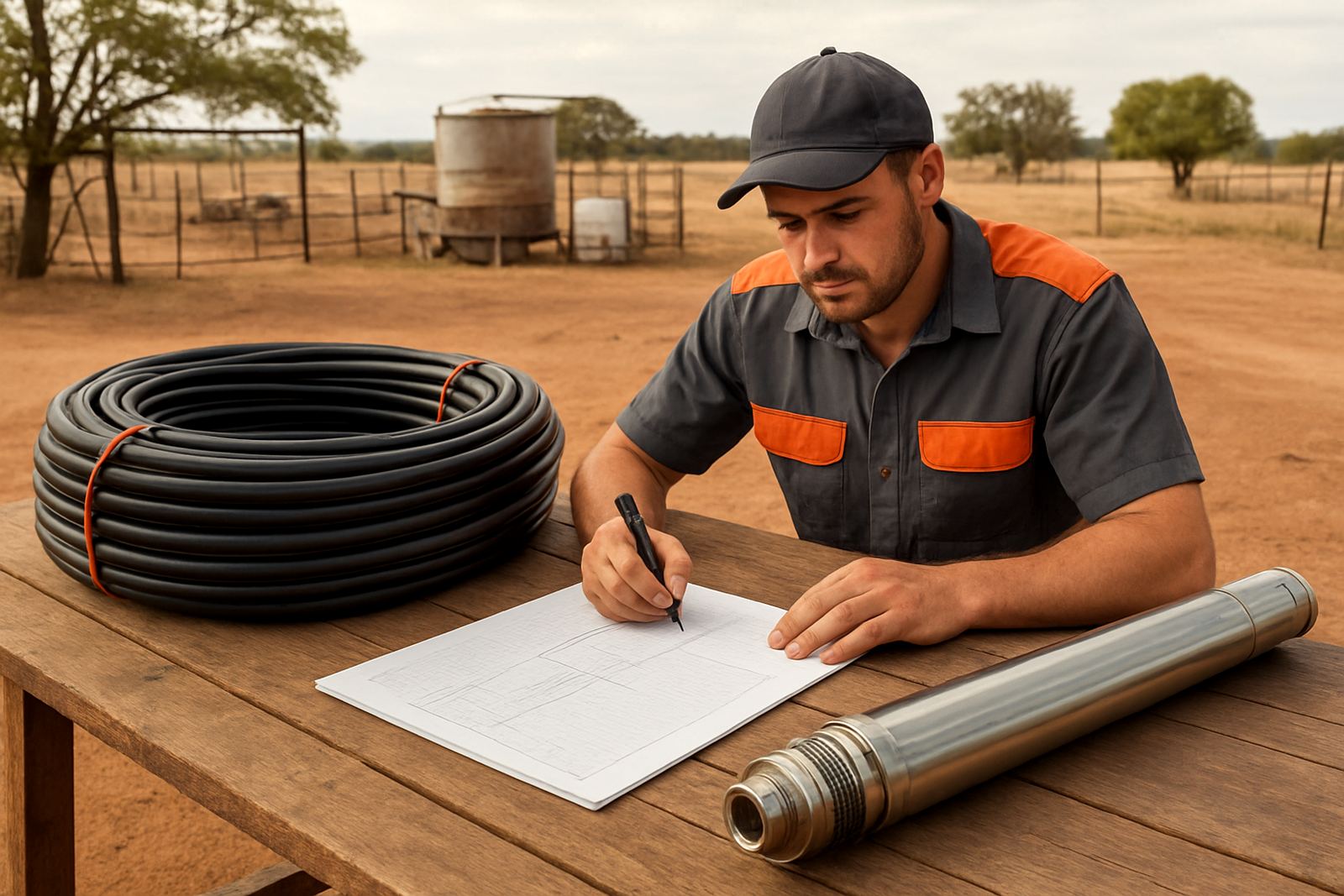
Start With the Borehole Facts, Not the Pump Brochure
The first job is to collect the borehole details. For a farm house in Kuruman, a small holding near Kimberley, or a residential plot in Upington, the pump choice depends on what the borehole can actually supply. If you guess, you may end up with too little water at the taps, or a pump that runs dry and burns out.
Ask for the borehole drillers report if you have one. If not, gather the basics yourself or with a technician. You need the total borehole depth, the standing water level, the pumping water level, and the borehole diameter. It also helps to know whether the borehole is in a sandy area, hard rock, or a mixed formation, because that can affect pump wear and the type of installation hardware needed.
- Total borehole depth in metres
- Standing water level after recovery
- Expected drawdown during pumping
- Borehole casing size and diameter
- Water quality notes such as sand, iron, or scale
If the borehole has not been tested properly, do that first. A pump should sit above the borehole floor and below the safe water level, with enough clearance for silt and movement. In the Northern Cape, where water can be deep and recovery slow, that detail matters more than shiny pump specs.
Work Out How Much Water You Actually Need
A pump is sized by demand, not by guesswork. A residential home in Galeshewe may only need water for bathrooms, kitchen use, and a small garden. A farm outside Upington may need stock watering, tank filling, irrigation, and home use from the same borehole. Those are very different jobs.
List every point that will use water and estimate daily demand. Think in litres per day and litres per hour. For a home, count toilets, showers, basins, washing machine use, and any taps outside. For a farm, add kraals, troughs, drip irrigation, line spray, and wash-down points. If the system must fill a storage tank first, note the tank size too.
- Number of people in the household or workers on site
- Daily water use for home, garden, livestock, or crop watering
- Peak use times, such as morning pressure demand
- Tank size and refill time required
- Any future expansion planned for the next 2 to 3 years
This is where many buyers go wrong. They choose a pump that can move lots of water, but not at the right pressure or at the right depth. A balanced choice is better than chasing the biggest number. You want enough flow for real use, not wasteful oversizing that shortens pump life and pushes up running costs.
Check Power Supply, Voltage, and Load-Shedding Backup
Before ordering a borehole pump, confirm what power is available on site. Is the supply single-phase or three-phase? Is the borehole running on municipal power, a generator, solar, or a mixed system? In places where load-shedding or weak supply is common, this decision affects the whole installation.
Write down the voltage and the available starting capacity. A pump may be suitable on paper but still trip a breaker if the cable is undersized or the starting surge is too high. If the borehole must work during outages, plan for solar backup, battery support, or generator integration. That way the pump can still fill the tank when the grid is off.
- Power source on site: grid, generator, solar, or hybrid
- Single-phase or three-phase supply
- Cable run length from the control point to the borehole
- Breaker size and protection devices
- Backup plan for outages and voltage dips
On remote properties, power losses over long cable runs can be a problem. A pump may start poorly if the cabling is too small or the joints are bad. Measure the distance properly and plan the electrical work with the pump selection. It saves time, and a lot of trouble later.
Match the Pump Type to the Job
Not every borehole needs the same type of pump. A residential borehole with moderate depth may suit a submersible setup, while a shallow application or transfer setup may use different equipment. The water level, pressure requirement, and water quality all influence the right option.
If the borehole water contains sand, ask for a pump and controls that can cope with those conditions, and make sure the borehole is cleared properly before long-term use. If you need steady pressure for a home, pressure tank size and switch settings matter just as much as the pump body. If the borehole must feed a storage tank only, the focus shifts more toward delivery rate and lift height.
Ask these questions before you buy: how deep is the water, how high must it be lifted, how much pressure is needed at the outlet, and how many hours a day will the pump run? A pump built for short domestic use may not suit a farm system that runs daily for stock or irrigation. Choosing based on application avoids overworking the motor and helps the borehole recover properly.
What to Bring When You Ask for a Quote
If you want an accurate quote, bring as much site information as possible. That helps the supplier size the pump, controls, cable, fittings, and any pressure or tank equipment. The more complete the information, the better the match for your borehole.
Use this checklist before you call or visit:
- Borehole depth, standing water level, and diameter
- Expected daily water use and peak demand
- Power supply details and backup requirements
- Distance from pump to tank, house, or irrigation point
- Water quality notes, including sand or scaling
- Photos of the borehole head, control panel, and tank area
If you are in Roodepan, New Park, or Galeshewe, it is also useful to note access for a service vehicle and whether the borehole area is enclosed. On farms around Kuruman and Upington, road conditions and site access can affect delivery and installation planning. A little detail upfront prevents delays later on.
Installation, Commissioning, and Ongoing Care
Buying the pump is only part of the job. Correct installation and commissioning are what make the system reliable. The borehole should be cleaned, the pump set at the correct depth, the cable secured properly, and the controls tested before full operation begins. If pressure settings are wrong, the system can cycle too often and wear components quickly.
After installation, keep an eye on flow rate, pressure, and power use during the first few days. Any sign of air in the line, muddy water, or repeated tripping should be checked immediately. A borehole that has just been commissioned can settle in, but it should not lose prime or run erratically.
For long-term care, flush the system where needed, inspect fittings, and keep records of running hours and repairs. If the site uses a tank, check float valves and overflow lines too. Small checks done early are cheaper than a full pump failure in midsummer.
If you are planning a new borehole system in Kimberley, New Park, or nearby areas, it helps to have both the pump and the install plan sorted together. That way the equipment, electrical supply, and water demand all line up from day one.